Friday, 14 September 2012

Review - Anna Kerenina


You know what it's like: you take a notion to go to the cinema and just rock up and see what's on. You can never be sure what your choice will be - and you may end up seeing something with little advance knowledge. So it was on Saturday when I ended up at the Cineworld in Fountainbridge in Edinburgh. Total Recall and The Bourne Legacy were both tempting - especially Total Recall in IMAX format - but there was a shorter wait for Anna Karenina and so she won out.
 
Now, my knowledge of the Classics is limited. My knowledge of the Russian Classics is even worse. That said, I had already decided that a little bit of education would do me good and this is the basis on which Anna Karenina was on my list of things to watch.
 
I was also intrigued by knowing that the film was set in a theatre - having heard about this on the wireless in an interview with the director who had described his experiences of searching for locations. Visiting stately mansions in Britain he would be told how they had been used for previous Keira Knightley films. Visiting similar properties in Russia, he would be told how they had been used for many adaptations of Anna Karenina already. Anxious not to make a retread of previous films he decided on the conceit of using a theatrical setting instead.
 
Much of the  film inhabits the sumptuous world of the Russian Aristocracy and has a lavish feel with occasional trips to the more austere surroundings of the Karenina family home in St. Petersburg and the impoverished home of one Nikolai Levin. The revolution which is apparently imminent is hinted at reasonably early on by Levin but as the film continued it became more and more apparent that this wasn't going to actually happen on screen. This is probably because, as I now know, the book was published some 30 years prior to it!
 
Knightley is good as the flighty Anna, bored at home in St. Petersburg with Alexai Karenin (played impressively by Jude Law, although I had to be informed of this afterwards!) and flaunting herself in Moscow Society with another Alexai - Vronsky. Love and Fidelity are fickle friends, though, and those that spurn the love of others are not immune from being spurned in turn.
 
In the absence of a broader political background - such as the hoped for revolution - the story becomes just a love story. (At this point, I began to wish I had paid closer attention to the posters which touted it as "an epic story of love".) Yes, it is a lavish, complicated, intense love story, but a love story none the less. For an old cynic like me (who is also not a fan of period dramas) this is not a film I would recommend. If epic love stories, sumptuous costumes and theatrically-shot films are your thing, though, then this is going to be a real treat.
 
Andrew

Wednesday, 12 September 2012

King Richard III, Leicester and Not So Hidden History

I'm not, it has to be said, a huge history buff - or at least, I'm not interested in History for History's sake. For me to get interested, there needs to be a hook or a narrative - like Radio 4's History of the World in 100 Objects, for example. Historical dates and context-less Archaeology leave me dry.

There has, however, been a story that has aroused my interest lately - an archaeological dig in Leicester. Jonathan Calder over on Liberal England visited the dig site on Saturday and reports on the fortuitous circumstances which have led to the discovery of a monastery and Robert Herrick's 17th Century Garden.

What has piqued my (and, of course, many others') interest is that the dig is also looking for the grave of Richard III. I find it intensely fascinating that the grave - and therefore body - of a King can become anonymous and all but disappear from public consciousness. Today it's been revealed that two skeletons have been found - one of which could indeed be that of Richard III. DNA analysis will take some weeks to complete but it truly is fascinating to think that the grave and body could be discovered and verified some 527 years after his death.
 
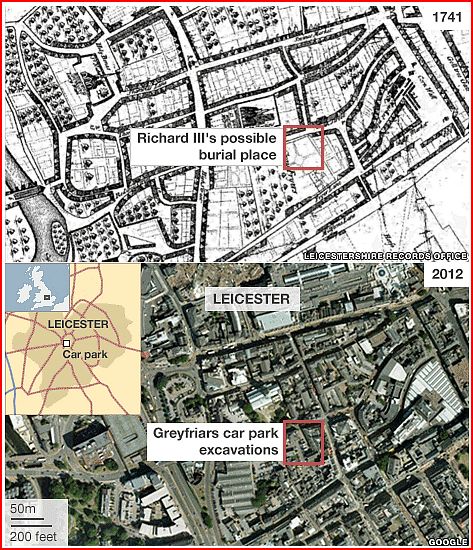
Something else has piqued my interest as a result of reading up on this story - how our land ownership laws have shaped our landscape. We tend to think of our cities as modern, vibrant places - and the architecture tends to reflect the wealthy periods of the past - Georgian and Victorian - or the necessary post-war reconstruction of the 60s and the property boom of the 90s. But scratch the surface and the way our forebears divided the land is still evident - as can be seen in this comparison from the BBC website:


Andrew

NOW! That's What I Call A Tune! 49

A slice of Hip-Hop/Rap this week, courtesy of OutKast. Ms. Jackson was one of those tracks that invaded my world from outside my normal range of musical likes. One of those "I'm not a big fan of... but..." moments.

This was their first big hit, followed some three years later by Hey Ya! and Roses. According to Wikipedia the band have been "On Hiatus" since 2007 - and AndrĂ© 3000 has a solo album in the offing... for now, he is one of the faces of Gillette...

Anyway, here is Ms. Jackson:


Andrew

Tuesday, 11 September 2012

Great Scot, Andy Murray's a Great Brit too...

Sean Connery has been in the news again. Along with Sir Alex Ferguson, he's been in New York supporting Andy Murray in the last major of the year, the US Open.

Sir Sean and Sir Alex interupted a press conference to congratulate Murray on winning his semi-final achievements and to - bizarrely - announce that Scotland had invented the world. (Scots may have invented many things but I'm not entirely sure the world was one of them.)

Murray followed up that win with a five set thriller against Novak Djokovic, coming out victorious after near-enough five hours of play. After four previous attempts, he demonstrated the same steel that saw him achieve Olympic Gold against Federer. 

Over the past few years, we've seen Murray mature physically, become less temperamental and become much stronger mentally. We've also seen him demonstrate just how much he wants to win - whether that be through the tears shed after he lost Wimbledon, or the single-minded play that took him to two Olympic medals.


As he has developed as a player and a person, he has become increasingly liked and respected by the public at large. And, of course, he has increasingly become "British" as opposed to "Scottish". Something which Sir Sean takes umbrage at when asked about his success:
"I always felt he had everything and now it's really come to fruition. I met him for the first time a couple of days ago. It's great for Scotland. We've had a really great landslide victory. And stop saying he's British, he's Scottish. I have to go now because the champion is waiting." (emphasis mine)

But why does it have to be either/or? Murray is British as well as Scottish, Scottish as well as British. It's a false dichotomy which many - on both sides of the border - are all too willing to play up. Why do we feel the need to polarise things?

Of course, polarised stories provide a narrative which real life doesn't slot into. In so many walks of life the media story is portrayed as good v. evil, right v. wrong, moral v. immoral when the reality is infinitely more nuanced. It's one of the reasons I don't blog on politics as much as I want to - but so often when a big issue comes out I can see good points and bad points on both sides of any given argument. Politics thrives on creating a polarisation of the issues - practical solutions depend on a more pragmatic approach.

But I digress - why can't I, Murray and millions of other Scots have a dual-identity. If these past few weeks have shown us anything, it is that Britain can be great - it can deliver international sporting events and infrastructure to the highest standard and it can deliver world class sporting performances. Athletes who can come together and contribute to the success of one TeamGB (and I include in that our ParalympicsGB team).

It has shown that the Scots, the Cornish, the Northern Irish, the Welsh, Manx Islanders, the Yorkshirish* can come together for a common goal while retaining different identities. It really isn't that hard a concept.

I'm happy to see Murray referred to as either or both, as long as it's done consistently whether he's won or lost. [A note to my English readers, though: no matter how much you try and make out you're just joking about him being British when winning/ a Scot when losing, it really isn't that funny anymore (and never was). It's time to move on.]

So here's to Andy Murray - a Great Scot and a Great Brit - and here's to many more Major wins! 

Andrew

*Made up word, obviously.

Saturday, 8 September 2012

Saturday Six 4

Welcome to another selection of six blogposts which have caught my eye over the past week. Here are this week's six:

Stephen shared some pictures of his day out at the Olympic Paralympic Park.

There was an interesting and innovative version of One Direction's "What Makes You Beautiful" on Michael's blog.

This piece on George Galloway from The Guardian's Clare Allan is bang on the money.

I'm not sure I'm quite there yet, but Nick Barlow makes a cogent argument for ending the coalition government - the reshuffle does nothing to reinvigorate the core reason for the coalition and rather more to give sucker to the Tory Right. Also in relation to the reshuffle, but specifically in relation to the return of David Laws to the Government, I agree with every word of what Mark Reckons.

Finally, I agree with this post from Stephen Tall - Reshuffle Honours are a grubby feature of our Honours system.

Andrew